
Psilocybin Biosynthesis Pathway
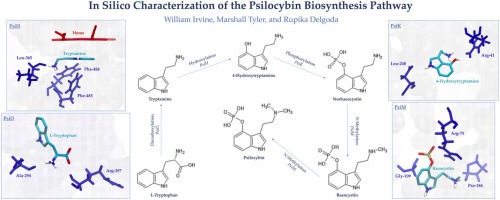
Psilocybin, a psychoactive compound found in Psilocybe mushrooms, has gained renewed interest for its potential in treating depression, but its biosynthetic pathway remains poorly understood. This study generated and refined structural models for the four enzymes involved in psilocybin synthesis (PsiD, PsiH, PsiK, and PsiM), confirming through molecular docking that they can bind and transform their expected substrates. The models also suggested plausible routes for the formation of related metabolites such as aeruginascin and DMT. These structural insights enhance understanding of psilocybin biosynthesis and open opportunities for developing novel substrates, selective inhibitors, and improved methods for biotechnological producti
-
Title
In silico characterization of the psilocybin biosynthesis pathway
-
Authors
William Irvine, Marshall Tyler, Rupika Delgoda
-
Publication
Elseveir - Computational Biology and Chemistry 104 (2023)
Research Abstract
Nearly all mushrooms of the Psilocybe genus contain the natural product psilocybin, which is a psychoactive alkaloid derived from l-tryptophan. Considering their use in ancient times, as well as their psychedelic properties, these mushrooms have re-emerged with psychotherapeutic potential for treating depression, which has triggered increased pharmaceutical interest. However, the psilocybin biosynthesis pathway was only recently defined and, as such, little exists in the way of structural data. Accordingly, the aim of this study was to structurally characterize this pathway by generating homology models for the four Psilocybe cubensis enzymes involved in psilocybin biosynthesis (PsiD, a decarboxylase; PsiH, a monooxygenase; PsiK, a phosphotransferase; PsiM, a methyltransferase). Following initial model generation and alignment with the identified structural templates, repeated refinement of the models was carried out using secondary structure prediction, geometry evaluation, energy minimization, and molecular dynamics simulations in water. The final models were then evaluated using molecular docking interactions with their substrates, i.e., psilocybin precursors (l-tryptophan, tryptamine, 4-hydroxytryptamine, and norbaeocystin/baeocystin), all of which generated feasible binding modes for the expected biotransformation. Further plausibility of the psilocybin → aeruginascin, 4-hydroxytryptamine → norpsilocin, and tryptamine → N,N-dimethyltryptamine conversions, all mediated by the generated model for PsiM, suggests valid routes of formation for these key secondary metabolites. The structural characterization of these enzymes and their binding modes which emerged from this study can lead to a better understanding of psilocybin synthesis, thereby paving the way for the development of novel substrates and selective inhibitors, as well as improved biotechnological manipulation and production of psilocybin in vitro.
Top Highlights
- Mushrooms of Psilocybe genus produce psilocybin, with important psychotherapeutic potential
- Synthesis of psilocybin is challenging, necessitating improved biotechnological production
- Structural models of enzymes in psilocybin biosynthesis yield new insight into mechanisms
- Models also confirm plausibility of synthesis routes for secondary metabolites in Psilocybe